Our AI servers are based here in the UK, at one of our purpose-built datacentres in South East England.
AI Servers
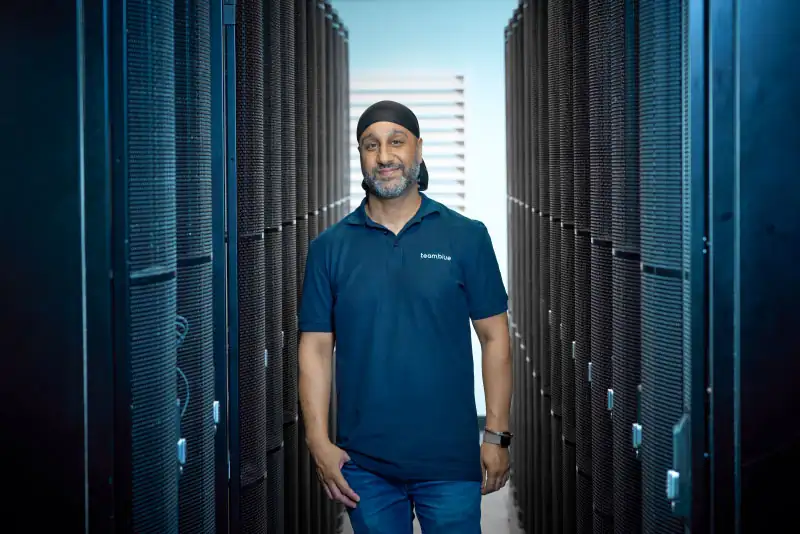
Powerful UK AI Servers
Our AI servers are designed for the most demanding of uses. Each is custom-built to order, using the latest state-of-the-art NVIDIA GPUs, Intel or AMD CPUs and high-speed NVMe SSDs.
Running your own LLM gives you complete freedom, flexibility and security – letting you process and analyse data however you see fit. Plus, you’ll be in safe hands with our expert UK support team at the end of the phone whenever you need them.
What are the advantages of an AI server?
Data Protection
Uploading confidential business data to an online AI model is risky.
Using your own AI server avoids this issue by keeping your sensitive data in-house and in the UK.
Custom Behaviour
A standard online LLM has various behavioural limitations.
An AI server gives you the freedom to configure the LLM with bespoke behaviour custom to you.
Predictable Costs
A typical AI model may have a subscription cost that changes regularly.
With an AI server you'll know exactly how much you'll be paying for the duration of the contract.
Reliable Performance
Using an online LLM puts you at the mercy of rate limits or usage caps.
An AI server has none of that and puts processing availability fully under your control.
Local Integration
It’s never ideal to expose your internal services to an external API.
With your own AI server you’ll have a much tighter integration, which can run fully offline if necessary.
Regulatory Needs
In some industries, there may be restrictions on where data can be sent.
An AI server keeps it within national borders and makes business auditing much easier.
Typical AI Server configurations
All prices are available monthly or yearly and are ex.VAT
Standard
- 1 x AMD EPYC 9554
3.1Ghz 64-Core CPU - 1 x Dell NVIDIA A100 80GB FH
Graphics Accelerator - 256GB RAM
- 2 x Dell 1.92TB NVMe SSDs
Business
- 1 x AMD EPYC 9554
3.1Ghz 64-Core CPU - 2 x Dell NVIDIA A100 80GB FH
Graphics Accelerator - 512GB RAM
- 2 x Dell 1.92TB NVMe SSDs
Enterprise
- 2 x Intel Xeon Platinum 8462Y+ 2.8Ghz 32-Core CPUs
- 4 x NVIDIA H100 NVL PCIe, 350W-400W 94GB Passive Double Wide Full Height GPUs
- 768GB RAM
- 2 x Dell 3.84TB NVMe SSDs
Need a custom spec?
The above configs are examples of our typical AI servers, but we are happy to quote for any type of system spec. Give us a call on 0800 107 7979 or request a quote online.
Frequently Asked Questions about AI Servers
-
Where are your AI servers hosted?
-
Can you recommend the top AMD EPYC based configurations for a customisable AI server?
Certain EPYC based configurations work especially well when building AI focused servers.
Here are strong options to consider:
- EPYC with dual GPU capable motherboards supports heavy training workloads
- EPYC paired with high bandwidth DDR5 suits data-hungry AI models
- EPYC combined with NVMe storage arrays improves dataset throughput
- EPYC in single socket layouts offers efficient AI inference capacity
These combinations help form a flexible base for AI system design.
-
What are the main advantages of AMD EPYC processors for a customisable AI server?
AMD EPYC processors bring key benefits when powering a customised AI server. Here are the main advantages they offer:
- High core density that supports intensive model training
- Strong memory bandwidth that accelerates data movement
- Abundant PCI Express lanes that simplify GPU expansion
- Improved efficiency which supports sustained AI workloads
This combination makes EPYC well suited to scalable AI focused systems.
-
How do AMD EPYC processors compare in price and performance for AI servers?
EPYC processors give strong price performance balance when building AI servers.
Here are the main factors to think about:
- They offer high throughput, which reduces accelerator bottlenecks
- They maintain competitive pricing across many core counts
- They lower running costs through strong performance per watt
- They provide good value for AI tasks that need parallel processing
This makes EPYC a reliable foundation for cost-aware AI solutions.
-
How do Intel Xeon processors compare in terms of power efficiency and performance?
Xeon processors offer a particular balance of efficiency and performance for commercial AI servers.
Here is how they stack up:
- They provide steady performance suited to AI inference and mixed workloads
- They show moderate power efficiency that supports long running services
- They deliver strong per core output that benefits sequential AI operations
- They use reliable thermal behaviour that stabilises server performance
This balance makes them suitable for predictable AI workloads in commercial environments.
-
Are NVIDIA A100 cards suitable for gaming or professional work?
NVIDIA A100 cards are engineered for heavy compute tasks rather than gaming. They fit different workloads by:
- Excelling at AI training and scientific computing
- Supporting large scale data processing far beyond consumer GPUs
- Delivering very strong performance for high end professional workloads
These cards are not optimised for gaming performance or consumer graphics features. Overall, the A100 is best used for professional compute focused environments.
-
How does the NVIDIA H100 compare to other high-end GPUs in performance?
The NVIDIA H100 leads most high-end GPUs in performance when deployed in AI servers.
This is because it:
- Offers unmatched AI training speed for large enterprise models
- Delivers exceptional inference throughput in production AI servers
- Provides superior memory bandwidth for demanding model architectures
- Outperforms earlier accelerators in both compute density and efficiency
This makes the H100 a benchmark for modern AI server performance.
-
What are the main features of the NVIDIA H100 GPU?
The NVIDIA H100 brings advanced features specifically designed for AI server workloads.
These include the following:
- Hopper architecture tuned for large scale AI computing
- Extremely high memory bandwidth for complex training tasks
- Advanced tensor operations that accelerate machine learning
- Strong scaling across multi-GPU AI server clusters
These features make the H100 exceptionally capable for AI workloads.
-
How does the NVIDIA A100 compare to other NVIDIA GPUs?
The NVIDIA A100 sits above most professional GPUs in commercial AI server performance.
Its advantages include:
- Far higher training throughput than mid-tier workstation GPUs
- Stronger inference acceleration than earlier data centre models
- Greater memory bandwidth than most other enterprise GPUs
These characteristics place the A100 among the highest performing NVIDIA GPUs.
-
What are the main features of the NVIDIA A100 GPU?
The NVIDIA A100 includes powerful features built specifically for commercial AI servers.
Its advantages include:
- Ampere architecture designed for large scale AI compute.
- High memory bandwidth suited to intensive training workloads
- Advanced tensor operations that accelerate machine learning tasks
- Strong performance scaling across multi-GPU systems
These features make the A100 a leading accelerator for enterprise AI.
-
What are the main differences between Intel Xeon processors and other server CPUs?
Intel Xeon processors differ from other server CPUs in ways that influence commercial AI server design. This is because they:
- Offer strong single core performance that helps certain AI preprocessing tasks
- Provide broad platform stability that suits long running commercial systems
- Support extensive software compatibility across enterprise AI frameworks
- Focus on predictable performance rather than extreme core density
These distinctions make Xeon a dependable option for stable AI workloads.
-
Is the NVIDIA H100 suitable for AI and datacentre applications?
The NVIDIA H100 is highly suitable for AI server and data centre applications. It offers the following benefits:
- Supports large scale AI training for commercial model development
- Excels at fast inference across enterprise deployment pipelines
- Integrates smoothly with modern AI server networking standards
- Maintains strong stability for continuous high intensity workloads
These traits make it ideal for AI focused datacentre environments.

What our clients say
Great real person support – direct phone number, usually the same individual so any problems are handled by the same people. Excellent.
Daniel Chandler, Vindico UK Ltd